How to Include Children in Pet Aquamation and Memorial Decisions

Children form deep, meaningful connections with family pets. Often, a pet is their first friend, confidant, or constant companion through childhood’s ups and downs. According to clinical guidance from the UC Davis School of Veterinary Medicine, a child's first encounter with death is typically the loss of a family pet. In many cases, including children in the decisions about what happens after their pet dies can help children overcome feeling confused, powerless, or unable to process their grief.
In our daily work serving families throughout the Sarasota and Bradenton areas, we frequently see how including children in aftercare decisions helps them overcome feelings of confusion, powerlessness, or isolation in their grief.
Including children in age-appropriate ways validates their relationship with the pet and acknowledges that their feelings matter. When handled with care, these conversations become foundational experiences in developing lifelong emotional resilience.
Building Healthy Attitudes Toward Loss
Talking to kids about pet aftercare and death, while difficult, offers critical life lessons. Insights from the American Academy of Child & Adolescent Psychiatry (AACAP) show that children who are included in these conversations in honest, gentle ways tend to develop healthier long-term attitudes toward mortality. They learn that sadness is natural, that saying goodbye is a part of loving deeply, and that families support each other through hard times.
Shielding children completely from the reality of death can accidentally fuel more anxiety. When we give them honest information tailored to their developmental stage, we help them build the emotional tools they will need down the road.
Preventing Emotional Confusion
Children have vivid imaginations. When adults avoid explaining what happened to a beloved pet, kids often fill in the gaps with scenarios far more frightening than reality. Some worry the pet is suffering somewhere, lost, or abandoned. Others might fear they did something to cause the illness or death. Clear, compassionate explanations provide closure and allow children to begin processing their grief cleanly.
Age-Appropriate Ways to Involve Children
Every child processes grief differently, but child development milestones provide an excellent baseline for how much detail to share.
Younger Children (Under Age 9)
Child development experts at UCLA Health note that children under nine process death very concretely and may initially view it as temporary or reversible.
The Language to Use: Use direct, honest language and entirely avoid confusing euphemisms like "put to sleep" or "went away." Bereavement counselors point out that phrases like "put to sleep" can spark severe bedtime anxiety in young children who take the words literally. Instead, explain the transition by saying: "Buddy’s body stopped working, and he died. His body cannot feel any pain anymore, and it won't start working again."
The Aquamation Conversation: Traditional flame cremation can sometimes introduce frightening concepts. The Ohio State University Veterinary Medical Center advises avoiding intense words like "fire" or "burned" with younger kids. This is where the gentle nature of Aquamation provides immense psychological comfort. You can explain that Comforting Currents uses a soothing, quiet flow of warm water and alkalinity—much like a warm bath—to gently accelerate the natural process of returning the pet's body back to nature.
Tangible Inclusions: Younger children process emotions through concrete actions. Invite them to choose a favorite toy or a blanket to sit near the pet before the process, or let them help select a child-friendly photo frame urn. A wonderful literary resource for this age group is the book “The Invisible Leash” by Patrice Karst.
Teenagers (Ages 14+)
By age 14, teenagers fully comprehend the permanence and abstract concepts of death. However, as noted by the American Academy of Pediatrics (AAP), teens often struggle the most with vocalizing their grief, sometimes feeling immense pressure to "be strong" or isolate themselves.
The Science Connection: Teens are often deeply comforted by the environmental science behind our facility's water-based process. Knowing that Aquamation generates zero greenhouse gas emissions and leaves a minimal footprint on the planet gives them a positive, logical focal point for their grief.
Active Partnership: Teenagers should be invited to participate as full participants. Ask them what level of involvement feels meaningful to them. They may wish to accompany you to our quiet facility at 6471 Parkland Drive, research custom memorial styles, or take the lead in designing a family farewell ritual. Many find solace in creative outlets, such as compiling digital video tributes or designing custom jewelry meant to securely hold a small amount of the clean, white mineral cremains.
Guidance for the Initial Conversation - Choosing the Right Time and Place
When possible, have this conversation in a quiet, comfortable space where everyone feels safe. Sit at their level, make eye contact, and be fully present. For a planned euthanasia—whether you choose to hold it at a local clinic, at home with a mobile vet, or within our serene Remembrance Room at Comforting Currents—discussing aftercare beforehand allows children to ask questions calmly.
If the death was unexpected, give yourself a moment to collect your thoughts before gathering the family. It’s completely okay to cry in front of your children. Showing your own sadness teaches them that grief is normal and nothing to hide.
Scripting the Explanation
Children benefit from direct, simple phrasing. Instead of “We lost Max,” say “Max died.” When discussing Aquamation, emphasize the gentle, natural elements of the water-based process:
"After a pet dies, families have choices about how to care for their body. We have chosen a very peaceful, gentle water process called Aquamation. It uses warm water to return Max's body back to nature without any fire, and it gives us back his quiet, white cremains that we can keep in a special place right here at home."
Practical Ways Children Can Participate - Before and During Aftercare
Depending on comfort levels, children might want to visit our facility to say a final goodbye to their pet's body in our private Memorial Room before the process begins. This provides powerful closure, though it should never be forced. Some children find deep comfort in placing a letter or a drawing alongside their pet.
Sharing appropriate details about our tracking system can also provide a sense of security to anxious children. You can let them know that Comforting Currents uses an indestructible stainless steel identification disc and a secure tracking system that stays with their pet every single step of the way, guaranteeing that the cremains brought home belong strictly to their cherished companion.
Memorial Planning and Ceremonies
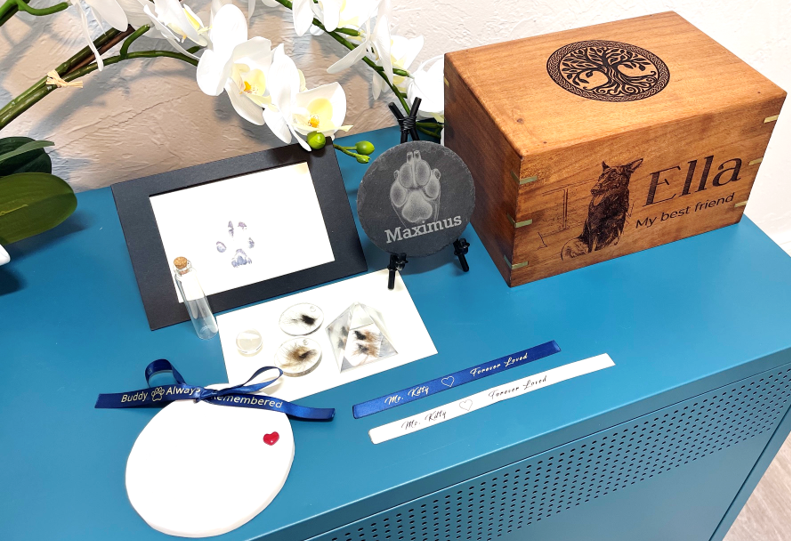
An array of engraved paw prints in stone, clay, and ink on paper next to a “Private Service” custom engraved wooden urn. There are other keepsakes of fur-clippings in resin taking different shapes such as a pyramid, sphere, or round wearable jewelery.
Family pet memorials offer numerous opportunities for active participation:
Creative Tributes: Have children write a letter, poem, or story about their favorite memories to read aloud, or draw pictures of the pet to place in a dedicated memory book.
The Memory Space: Let them choose a special place in the home for a memory shelf to hold the urn, paw prints, and photos.
Signs Your Child Needs Additional Support
Most children will show signs of grief like sadness, mood fluctuations, temporary sleep disruptions, or changes in appetite for days or weeks after a pet’s death. This is normal.
However, watch for prolonged behavioral changes lasting more than a few weeks. Severe withdrawal from friends, a sudden drop in school performance, intense self-blame about the pet’s death, or frequent physical symptoms like unexplained stomachaches or headaches warrant a compassionate conversation with a pediatrician or a professional counselor specializing in childhood grief.
The Gift of Shared Grief
When you include your children in pet aftercare decisions, you’re teaching them that love and loss are inseparable, that families face hard things together, and that there are peaceful, respectful, and environmentally beautiful ways to honor a lifetime of companionship.
At Comforting Currents, we are always here to help walk your entire family through this transition with the highest standard of local care, grace, and dignity.
Written by: Chris Cavis: Partner / Director of Customer Services and Content (https://www.linkedin.com/in/chriscavis21326195/)
Chris’s first and continued passion is for storytelling, a journey that eventually led him to the University of Florida, where he earned his Master’s degree in Journalism. He values the ethical responsibility as a journalist to fact-check, acquire multiple reliable sources, and follow the Society of Professional Journalists Code of Ethics. Today, Chris is a Partner of Comforting Currents and serves as the Content and Office Manager at Comforting Currents, where he blends professional expertise with a passion for service. A lifelong animal lover, Chris grew up surrounded by pets, a background that fostered a profound empathy for families navigating the difficult journey of pet loss.